Notice: Test mode is enabled. While in test mode no live donations are processed.
Rising for Justice provides free legal and social work services to low-income DC residents while training the next generation of public-interest advocates through clinical programs and partnering with pro bono attorneys to expand access to justice.
When Washington, DC residents face dangerous living conditions, exploitative landlords, or record-based barriers to opportunity, Rising for Justice stands with them to prevent displacement, promote stability, and build more secure futures.
We leverage the collective forces of students and experienced advocates to achieve a District of Columbia where all residents live safely, securely, and with dignity, and where access to legal protection and economic stability is not determined by income, race, immigration status, or prior system involvement.
Each year, Rising for Justice’s attorneys, social workers, pro bono partners, and student advocates serve more than 6,200 residents, strengthening communities and shaping a more just DC.
In 1967, Judge Timothy Murphy penned an article for the DC Bar Journal that revealed a stark power imbalance in DC Court’s Small Claims and Conciliation Branch: fewer than 2 percent of tenants facing eviction had legal representation, while 90 percent of landlords appeared with counsel. For families living on the margins, this disparity often meant displacement from their homes without the opportunity to be heard.
Rather than accept this disparity as inevitable, a coalition of attorneys, judges, and law school leaders sought a solution that expanded access to counsel. The answer was both pragmatic and transformative: empower law students to expand representation without sacrificing quality or accountability.
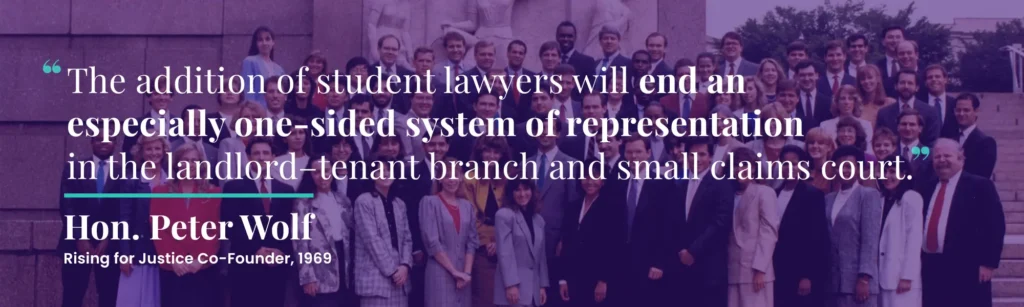
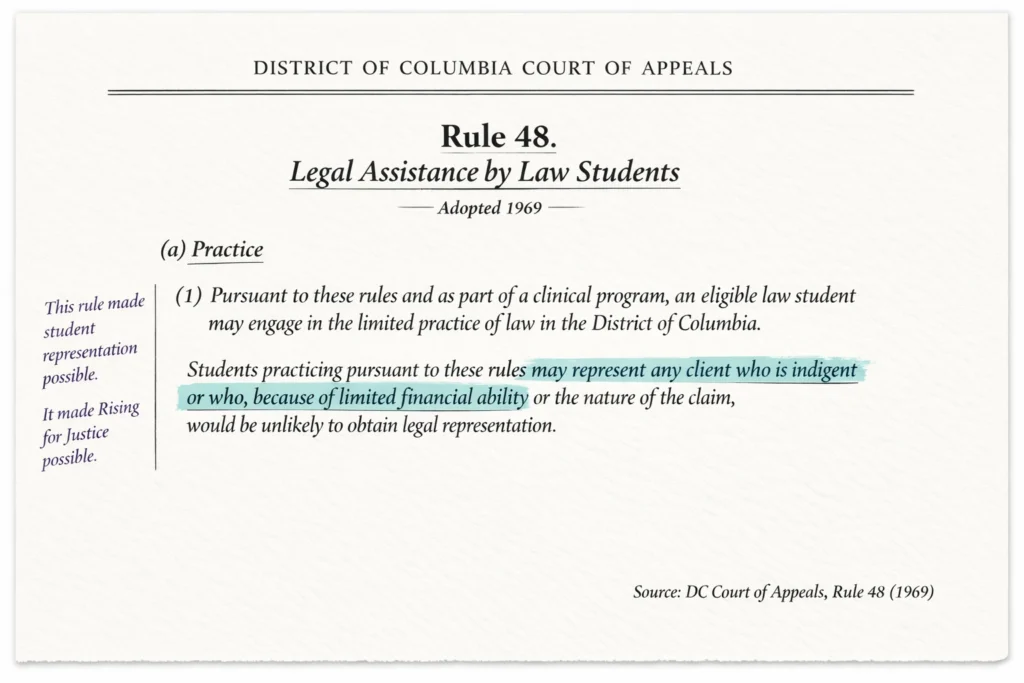
Judge Peter Wolf led the Task Force on Representation of Indigents by Third-Year Law Students, which culminated in a landmark reform when the DC Court of Appeals adopted Rule 48 in 1969, which authorized eligible law students in clinical programs to represent clients under attorney supervision. This approach made it possible to dramatically increase the number of tenants with advocates while maintaining professional standards.
Rule 48 fundamentally expanded access to justice in DC and led to the creation of DC Law Students in Court in 1969, the organization that would later become Rising for Justice. By 1970, the organization sent its first cohort of 36 law students into landlord-tenant court, bringing fairness and skilled advocacy to a system that had long favored power and wealth.
55+ years, 5,000+ student trainees, and 250,000+ clients later, Rising for Justice remains rooted in that same principle that access to justice should not depend on income, status, or circumstance.
901 4th Street NW, Suite 6000
Washington, DC 20001
All Rights Reserved © Rising for Justice 2026